
A01
Market and role mapping
Active destinations, skill demand, hiring restrictions, sector pressure points and intake priorities are assessed before profiles are routed.
Global Workforce is a coordination-led overseas recruitment platform built to keep applicants, manpower suppliers and employers aligned through route screening, document discipline, interview readiness and post-submission visibility.
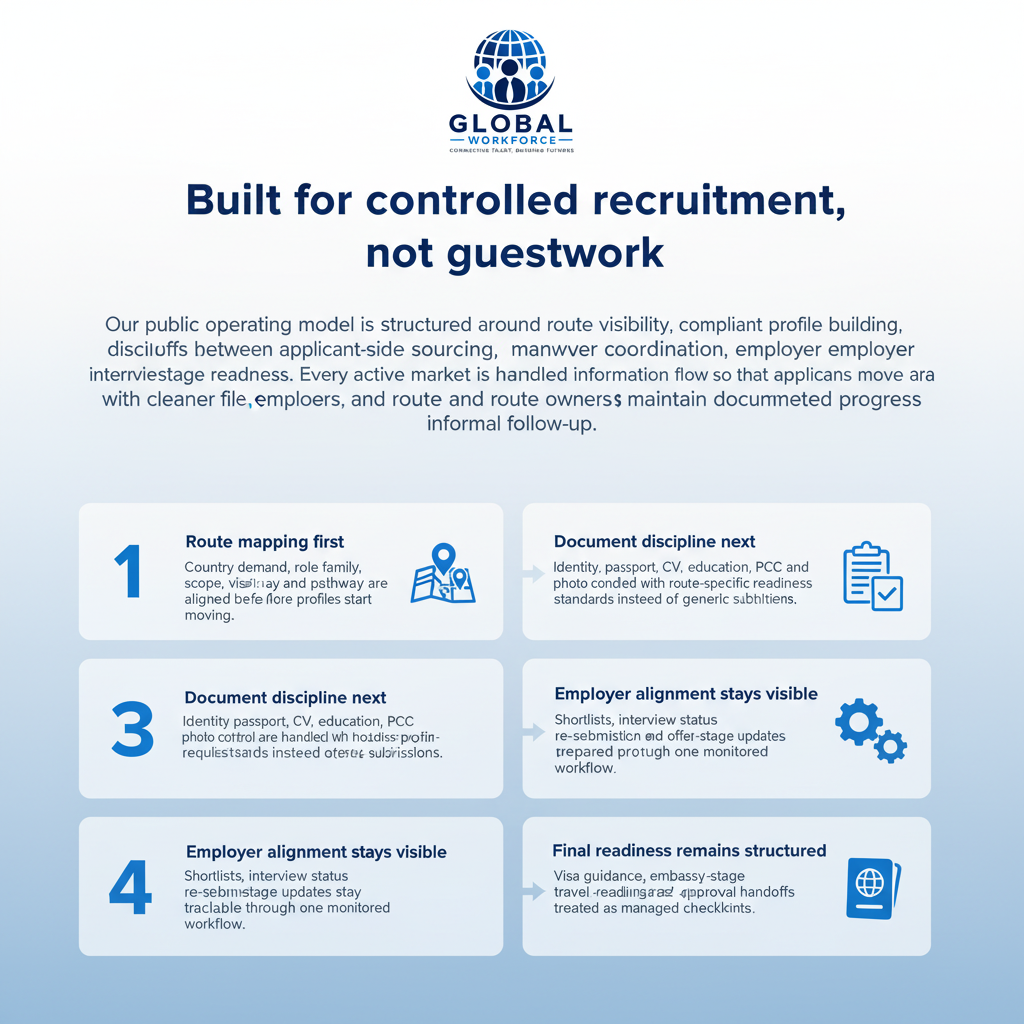
Our public operating model is structured around route visibility, compliant profile building, and disciplined handoffs between applicant-side sourcing, manpower coordination, employer requirements and interview-stage readiness. Every active market is handled through a controlled information flow so that applicants move with cleaner files, employers receive better prepared profiles, and route owners maintain documented progress rather than informal follow-up.
Country demand, role family, eligibility scope, visa pathway and employer-facing expectations are aligned before profiles start moving.
Identity, passport, CV, education, PCC and photo control are handled with route-specific readiness standards instead of generic submissions.
Shortlists, interview status, re-submission needs and offer-stage updates stay traceable through one monitored workflow.
Visa guidance, embassy-stage preparation, travel-readiness notes and post-approval handoffs are treated as managed checkpoints.
Global Workforce follows a documented operational arc from demand mapping to final route handoff, keeping each stage visible for applicants and hiring-side stakeholders.
Active destinations, skill demand, hiring restrictions, sector pressure points and intake priorities are assessed before profiles are routed.
Candidate records are gathered with clear contact, family-reference and identity information so early-stage errors do not follow the route forward.
Passport, CV, education, PCC, white-background photo and support records are assembled into cleaner employer-ready files.
Each submission is checked against country conditions, role requirements, sector expectations and document-sensitive checkpoints.
Profiles are prepared in a cleaner structure so downstream reviewers spend less time decoding incomplete or inconsistent candidate files.
Scheduling, clarification requests, re-submissions and interview-stage readiness remain part of the monitored workflow, not an off-platform gap.
Offer letters, status updates, visa-stage guidance and outstanding file issues stay visible until the route reaches decision stage.
Final route notes, deployment readiness and movement coordination are documented so transitions remain traceable beyond the first approval stage.
Our track record is strongest where route volume, document discipline and employer-side timing all matter at the same time.
Large-volume hiring environments where speed, document readiness and interview coordination all affect placement quality.
Country-route support for industrial, general worker, packing, hospitality and warehouse-facing opportunities.
Role families where consistent shortlist formatting and basic compliance control improve downstream selection.
Service-sector pathways that depend on cleaner profile presentation, duty-fit alignment and movement readiness.
Trust is built through repeatable controls: cleaner files, clearer route visibility, disciplined follow-up, and better handling of changes before they become hiring delays.
Candidate files are structured around route requirements instead of one generic submission stack, reducing rework and preventable document churn.
Applicants, manpower coordinators and hiring-side stakeholders stay tied to one monitored route story rather than fragmented messages and disconnected updates.
Interview, embassy and movement-stage issues are surfaced earlier, which helps routes progress with fewer avoidable surprises.
Use the careers board, sector pages and contact desk to review active destinations, job visibility and route-ready hiring support.